CLAT PG Coaching in Jaipur: The Complete Guide to LLM Preparation Online and in Jaipur
Searching for CLAT PG coaching in Jaipur means you already know something important – that the exam sitting between you and an NLU LLM seat is not one that responds well to last-minute preparation or generic study plans.
CLAT PG 2027 is scheduled for December 6, 2026. One hundred and twenty questions. Two hours. Negative marking. Passage after passage of dense legal material that rewards the candidate who reads fast, understands deeply, and makes accurate decisions under pressure.
If you are in Jaipur – or anywhere in Rajasthan – and want preparation that actually matches what the exam demands, this is where to start.
What Makes CLAT LLM Different From Everything Else You Have Studied
Three years of LLB builds legal knowledge. CLAT PG tests legal comprehension. Those are not the same thing.
The exam gives you a passage — drawn from a court judgment, a statute, a legal commentary — and asks you questions about it. Not questions that require you to recall what you studied. Questions that require you to understand what is in front of you, identify the principle being applied, and pick the most legally accurate answer from four options that are all designed to look reasonable.
The candidate who has read every important judgment but has never practised passage-based comprehension under time pressure consistently underperforms against the candidate who has done less reading but far more application practice.
CLAT PG tests comprehension ability through passage-based questions covering Constitutional Law, Jurisprudence, Contract Law, Criminal Law, and other law subjects — with negative marking of 0.25 marks for each wrong answer.
CLAT PG 2027 offers approximately 1,600 seats for LLM programmes across 26 participating National Law Universities. With those seats spread across general, OBC, SC/ST, EWS, and state domicile categories — and with thousands of LLB graduates appearing — preparation quality genuinely decides who gets in.
Why Jaipur Is a Serious Location for CLAT PG Preparation
Jaipur has something most cities in India do not have — the Rajasthan High Court.
This matters for CLAT PG preparation more than most candidates realise. The High Court produces constitutional and criminal law decisions regularly. Advocates who appear before it understand judicial reasoning not as an abstract concept but as something they engage with professionally. When a CLAT LLM passage is drawn from a High Court or Supreme Court decision — which happens consistently — a candidate who has been taught by a practising advocate reads that passage differently. The reasoning structure is familiar. The legal argument is recognisable. The answer becomes clearer faster.
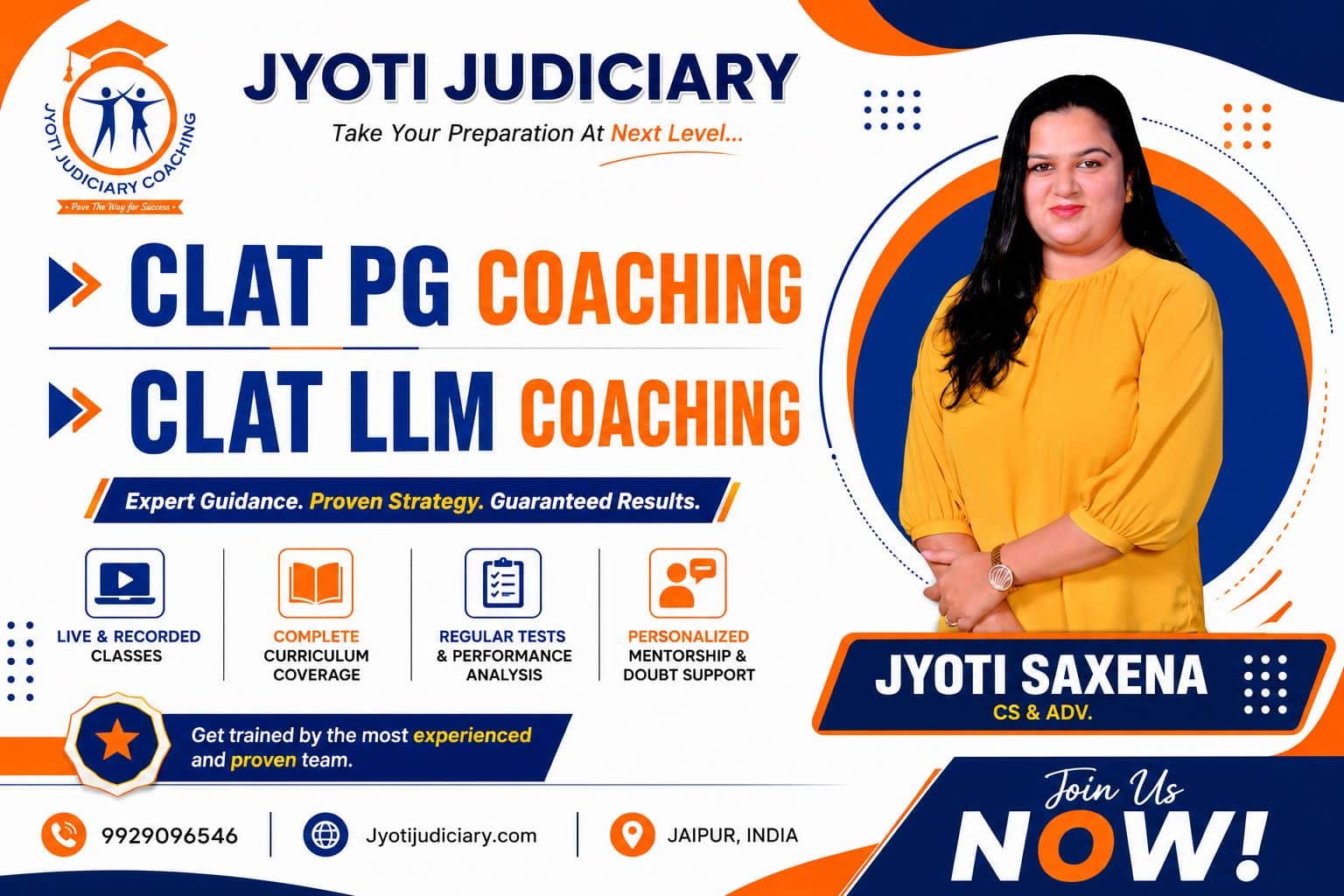
At Jyoti Judiciary, CLAT PG coaching in Jaipur is led by Advocate Jyoti Saxena — LLB, LLM, Company Secretary — with over a decade of active practice before the Rajasthan High Court, Jaipur Family Court, and Jaipur District Court. Twelve years of mentoring judiciary aspirants. Numerous successful civil judge candidates. The preparation she offers for CLAT LLM is built on the same foundation — practical legal understanding applied to examination performance.
That combination is genuinely rare. Most coaching programmes for CLAT PG are built around academic content delivery. Jyoti Judiciary brings courtroom experience into the preparation room.
CLAT PG Online Classes — What Jyoti Judiciary Offers
For candidates across Rajasthan and across India, Jyoti Judiciary’s CLAT PG online classes run as a structured programme — not just recorded content sitting on a platform waiting to be watched.
The programme combines recorded lectures for concept coverage with live online sessions for the parts that actually require human interaction — judgment analysis, passage-based question discussion, doubt resolution, and mock test review.
Recorded lectures allow you to move through subject content at your own pace. Constitutional Law, Jurisprudence, BNS and BNSS for criminal law, Contract, Family Law, Torts, Company Law, Labour Law, Property Law, Public International Law — all ten CLAT PG subjects, updated with the new criminal law codes that replaced IPC, CrPC, and the Evidence Act from July 2024.
CLAT PG live classes are where the actual skill development happens. Reading a legal passage and identifying the right answer is something you learn by doing it with guidance — not by watching it being done. The live sessions at Jyoti Judiciary focus on exactly this: working through passages together, understanding why one answer is correct and the others are not, and building the reading precision that the exam rewards.
Mock tests are built into the programme from month two — not saved for the final weeks. Full-length mocks under actual exam conditions, with detailed review sessions. Candidates who join structured coaching with regular mock tests and performance analysis typically score significantly higher than self-preparation candidates.
The Syllabus — And the Part Most Candidates Get Wrong
Ten subjects. One hundred and twenty questions. Two hours.
Constitutional Law carries the highest weightage. The passages here come from landmark decisions — Kesavananda Bharati, Maneka Gandhi, Navtej Singh Johar, the basic structure doctrine, Article 21 jurisprudence. The questions do not test whether you know the case name. They test whether you understand the constitutional reasoning and can apply it correctly in a new context.
Jurisprudence trips up candidates who have only memorised positions. Hart, Fuller, Dworkin, Rawls — CLAT PG does not ask you to name-check these thinkers. It gives you a passage that applies a theoretical framework and asks you to identify it, extend it, or distinguish it. Candidates who have genuinely engaged with the arguments handle these passages confidently.
Criminal Law means BNS — not IPC. The Bharatiya Nyaya Sanhita 2023 replaced the Indian Penal Code from July 2024. CLAT PG 2027 passages in criminal law will be based on BNS, BNSS, and BSA. Preparation material that has not updated to reflect the new codes is preparing you for passages that will not appear in the paper.
Contract Law, Torts, Family Law, Company Law, Labour Law — these subjects appear consistently. Understanding the core principles and the key cases in each area is the right goal, not comprehensive statutory coverage. Public International Law appears every year — sources of international law, treaty interpretation, state responsibility, diplomatic immunity.
Professional Ethics — the Advocates Act 1961 and BCI Rules — appears in CLAT PG as well. Small in weightage but consequential for candidates who skip it entirely.
Who Should Consider CLAT PG Online Classes From Jaipur
The honest answer: most serious CLAT LLM aspirants benefit from structured preparation, regardless of where they are located.
If you are in Jaipur or Rajasthan, Jyoti Judiciary’s CLAT PG coaching gives you the additional advantage of faculty grounded in the local legal ecosystem — someone who has appeared in the courts whose decisions appear in your exam passages.
If you are elsewhere in India, the CLAT LLM online coaching gives you access to the same preparation through live sessions, recorded lectures, and structured mock tests — with the practical legal insight that comes from a practicing advocate with active courtroom experience.
Online CLAT PG coaching has become one of the most accessible solutions for candidates across tier two and tier three cities who lack access to good coaching institutes locally. The flexibility of recorded sessions and live online classes means the quality of your preparation is no longer determined by your geography.
The Preparation Timeline — Six Months That Actually Work
CLAT PG 2027 is in December 2026. Starting now gives you six to seven months.
Months one and two — foundation. Constitutional Law and Jurisprudence first. Read judgments — not summaries, actual decisions or detailed analyses. Understand the court’s reasoning. Begin BNS, BNSS, and Contract Law alongside. The goal is not coverage. It is comprehension of the most important material.
Months three and four — application. Passage-based practice becomes the primary activity. Daily sessions of reading dense legal passages, answering MCQs, and reviewing every wrong answer with explanation. Continue covering remaining subjects alongside.
Months five and six — mock tests and refinement. Full-length mocks under actual conditions. Detailed review. Targeted revision of subjects where accuracy is consistently below acceptable. The final month: revision only. No new material.
This structure works because it mirrors what the exam demands — deep understanding first, application practice second, exam simulation third.
Frequently Asked Questions
What is CLAT PG 2027 exam date?
CLAT PG 2027 is tentatively scheduled for December 6, 2026. Registration is expected to open in August 2026, with the official notification from the Consortium of NLUs in July 2026. Always verify the current schedule at consortiumofnlus.ac.in.
Is CLAT LLM difficult to crack?
Competitive, not impossibly difficult. The passage-based format rewards preparation that builds both subject understanding and reading comprehension speed. Candidates who prepare specifically for the exam format consistently outperform those with stronger academic backgrounds but less application practice.
How are CLAT PG online classes structured at Jyoti Judiciary?
The programme combines recorded lectures for subject coverage with live weekly sessions for passage analysis, judgment discussion, and doubt resolution. Mock tests begin from month two, with full-length exams and detailed review sessions built into the schedule.
Can candidates from outside Jaipur join CLAT PG online coaching?
Yes. Jyoti Judiciary’s CLAT LLM online classes are accessible to candidates anywhere in India. Live sessions, recorded lectures, mock tests, and doubt-clearing sessions are all available online.
Which NLUs accept CLAT PG scores?
Twenty-six National Law Universities participate in CLAT PG. NLU Delhi conducts AILET PG separately and does not accept CLAT PG scores. Many private law universities and PSUs also use CLAT PG scores for LLM admissions and legal officer recruitment.
Is CLAT PG only passage-based?
Yes — entirely. All one hundred and twenty questions are based on passages from primary legal materials. There are no standalone factual or definition-based questions. Everything is comprehension and application.
How is Jyoti Judiciary different from other CLAT PG coaching programmes?
The programme is led by Advocate Jyoti Saxena — a practising advocate with active High Court experience. Judgment analysis is taught the way a working advocate reads judgments, not the way a textbook summarises them. This practical dimension makes passage-based questions genuinely more accessible.
For CLAT PG Coaching in Jaipur and Online Across India
For CLAT PG 2027 preparation, online classes, live sessions, recorded lectures, and LLM coaching under Advocate Jyoti Saxena and the Jyoti Judiciary team:
Contact: 9929096546
Jyoti Judiciary — Jaipur. CLAT PG and CLAT LLM coaching available online across India.
────────────────────────────────────────────────────────────
This article is for general guidance and informational purposes. CLAT PG 2027 exam dates, syllabus, and eligibility are set by the Consortium of NLUs and are subject to change. Verify current details at consortiumofnlus.ac.in before making preparation decisions.
────────────────────────────────────────────────────────────
About the Author
Advocate Jyoti Saxena holds LLB, LLM, and Company Secretary (CS) qualifications and is enrolled with the Bar Council of Rajasthan. She has over a decade of active practice before the Jaipur Family Court, Jaipur District Court, and the Rajasthan High Court, handling matters related to family law, cyber crime, criminal defence, and civil litigation. She is the Chief Mentor at Jyoti Judiciary, where she has been guiding judiciary aspirants for over 12 years and has mentored numerous successful civil judge candidates. She regularly writes on judiciary preparation, case laws, and legal developments. This article has been written and reviewed for legal accuracy based on her experience in active practice.

You may also like

Rjs online coaching

Law Coaching in Jaipur
